Using a Co-Packer for the First Time: What It Costs and What to Track
What a co-packer costs on a first run: the per-unit fee, setup, minimums, and deposit. Plus how to vet one, the contract terms, and five numbers to track.

Article written by
Peasy

A co-packer, or co-man, makes your product in their facility, to your recipe, for a fee. The finished goods are still yours. So are the count, the lot records, and the recall plan.
You usually go looking for one when your kitchen can't keep up. A distributor order is too big to fill by hand, a retailer wants a certified facility, or the product needs equipment you'll never buy.
On a simple product, expect $0.20 to $0.60 a unit in fees, plus a setup charge near $2,000 every run. We'll walk through how co-packers charge, how to vet one, the contract, and the five numbers to track.
We make Peasy, free inventory ops for small CPG brands, and at the end we'll walk through how a co-packer run works in it.


What a co-packer is, and what it isn't
Co-packer, co-manufacturer, co-man, and contract packager all name the same job. They make your product to your formula, and your brand goes on the label.
Two other partners get mixed up with it:
Partner | Makes your product? | Whose recipe? |
|---|---|---|
Co-packer | Yes | Yours |
Private label maker | Yes | Theirs, under your brand |
3PL (warehouse) | No, it stores and ships | Not applicable |
A co-packer gets you out of the kitchen without buying a building or hiring a line. What you give up is some control. You're on their schedule, at their minimums, and working from their count of your stock.
Turnkey vs tolling co-packing deals
Every co-packing deal is one of two shapes, or a mix. The shape decides what you pay and what you have to track.
Turnkey | Tolling | |
|---|---|---|
Who buys materials | The co-packer | You |
What you pay them | One price per finished unit | A fee per unit or per batch, plus your own materials |
Cash up front | Lower | Higher |
What you track | Finished goods in | Materials out, used, and left, plus finished goods in |
Split deals are common. The co-packer sources the commodity ingredients and you supply the printed packaging. Film with your logo on it is yours to order.
Even on a turnkey deal, ask them to itemize the material costs. You can't push back on a number you can't see.
How much does a co-packer cost?
A first run costs about $0.20 to $0.60 a unit in conversion fees, plus setup near $2,000 every run, a 30% to 50% deposit at booking, and your materials.
The per-unit price on the quote is only one of six lines you'll pay. Here's what they typically run in 2026 for a simple shelf-stable product:
Conversion fee: The labor and line time, about $0.20 to $0.60 a unit at moderate volume. Some co-packers quote it per batch or per pound instead.
Setup and changeover: Cleaning and resetting the line. You pay it every run, whatever the run size. Near $2,000 for a simple setup, more for allergen-heavy lines.
Minimum run: The minimum order quantity, or MOQ, is usually 5,000 to 50,000 units per SKU. Specialty small-batch co-packers take sauces and condiments at 500 to 3,000 jars, at a higher unit price.
Materials: On their invoice (turnkey) or bought by you (tolling).
Deposit: 30% to 50% at booking, with the balance at shipment.
Extras: Storage, pallets, outbound freight, lab tests, and rush fees.
Why small first runs hurt
The reason small runs hurt is that setup is a fixed cost. So the run size decides what it does to your unit cost.
Say the first run carries $3,000 of combined setup and changeover, and the variable cost is $0.95 a unit. Spread over 1,500 units, setup adds $2.00, for $2.95 all in. Spread over 30,000, it adds 10 cents.
So rerun every quote at the run size you'll really order, not the one that makes the unit price look good. Carry the result into your cost per unit, and ask whether the price holds for a year.
Costs that show up after the quote
A few costs never make it onto the quote. You'll usually find them on your first or second run:
Packaging overage. Many co-packers want extra cans, film, or labels on top of the run, because the line loses some. Ask for the percentage and order it with the run.
Leftover materials. Supplier minimums rarely match the co-packer's. So you end up owning a full roll of film or a spare tote that sits at their site.
Fee creep. A per-unit charge that goes up a few cents every couple of months adds up. Write down each run's fee so you see it when it moves.
Freight to your warehouse. It often comes as its own bill, separate from the production invoice. It still belongs in that run's cost.
How to find and vet a co-packer
Start with smaller co-packers. Larger plants generally take only large runs, and you can get lost there. A smaller one will run a first batch you can sell through.
Many don't advertise. So search for "contract packaging" and "private label" as well as "co-packer", and ask brands in your category who makes theirs.
What to have ready before you call
A formula by weight, with ingredient sources and allergens. A bench sample in grams isn't a production recipe. Ask the co-packer what batch size they run, and build your formula from that.
Process steps, with equipment, temperatures, and times.
A packaging spec and a realistic demand forecast. Don't inflate the forecast to clear a minimum.
A process authority letter for acidified or low-acid foods. An acidified food's process has to be set by a qualified person with expert knowledge of acidification, and the co-packer will ask for it.
Questions to ask every candidate
What's your minimum run, and what's the full cost of every service, including fees not on the quote?
Can you run my packaging format to my spec?
Can I see your food safety plan, and your latest inspection or a GFSI-benchmarked audit like SQF or BRC?
How far ahead do I confirm a run, and how do you handle a rush?
Will you send a run report after every batch, with units made, units rejected, materials used, and materials left?
Can I talk to two brands you make product for?
Then walk the floor. Look at how ingredients are stored, how labels are checked, and how clean the line is. Run a pilot batch before you commit to volume.
How long a first run takes
Lead times stack. Printed labels can take a couple of weeks, the run a couple more, then freight on top.
Some brands plan three months from order to shelf. Work backward from the date you need product.
What to put in the co-packer contract
Ordering PO by PO is fine for a pilot. Once you're running volume, get it in writing. Have an attorney read it first, and your accountant too if the money terms are anything but simple.
Term | What to pin down |
|---|---|
Volume and minimums | Run size, frequency, and what happens below the minimum |
Lead time | Days from PO to finished goods, and the rush policy |
Price | Every fee itemized, how long prices hold, what justifies an increase |
Yield and loss allowance | The loss you accept per run, and who pays past it |
Who buys materials | Turnkey, tolling, or split, item by item |
Who holds what | Storage of your materials and finished goods, and insurance on them |
Run reports and counts | A run report after every batch, and a count of your stock on request |
Lot codes and COAs | Your lot code on every case, documents for every lot |
Records and audits | Your right to see production and quality records, or send an auditor |
Recalls and complaints | Who investigates, who pays, who calls whom |
Confidentiality and exit | Formula protection, notice period, and how your materials come back if you leave |
The exit clause matters more than it looks. If your co-packer fails or drops you, you can lose your retail accounts while you hunt for a new plant. Know which second co-packer you'd call.
What to track after every co-packer run
Stock sitting at a co-packer is still your inventory and still on your balance sheet. Their run report is the only view you get of it, and a short run looks like a full one until you check.
So track five numbers on every run:
What you sent: Every material shipment, with quantities and your suppliers' lot numbers.
What they used: Materials consumed, from their run report.
What they're holding: Sent minus used, still at their site.
What you received: Finished goods counted in at your warehouse or 3PL.
Loss per run: What the recipe says you should have gotten, minus what arrived.
On a turnkey deal, you only need the last two. Even on a tolling deal, start there, and add the materials once finished goods are steady.
Loss is the number to watch
Co-packers rarely deliver the exact count. Some overmake on purpose so you're never short. Record what arrived and pay against that, not what the PO said.
Say you send materials for 5,000 jars and the contract allows 3% loss. You should get at least 4,850. If 4,600 arrive, you're 400 short of the recipe and 250 past the allowance.
The contract decides who pays for those 250, and the run report says where they went. If you don't have a run report, add one to the contract before the next run.
Getting the numbers out of a co-packer
Most co-packers won't log into your system. They'll email a run report or a batch sheet, and you key it in. Ask for it in the same format every time.
Once a month, ask them to count what they're holding of yours, as a quick audit. Watch the unit, though: they may report rolls of film when you track labels each. Reconcile against your records and note the adjustment.
Who receives your packaging matters too. If it ships straight to the co-packer, a misprint (red lids instead of black) can reach the line before anyone on your side sees it. So inspect the first delivery of anything new.
Lot codes, COAs, and recalls with a co-packer
Your name is on the label, so the responsibility is yours too. When someone else makes your food, FDA requires your name on the label to say how you're connected, with wording like "Manufactured for" or "Distributed by".
In an FDA-requested recall, the recalling firm is the one with primary responsibility for the manufacture and marketing of the product. As the brand, that can be you.
Agree on three things before the first run:
Your lot code on every case. A co-packer usually issues one lot code per run, not twenty per pallet like a hand-made batch. Record their code as your finished lot, or have them print yours.
COAs both ways. Ask for a certificate of analysis or batch sheet with each finished lot. Expect them to ask you for COAs on the materials you supply.
Ingredient lots per run. If you supply materials, record which of your lots went into each run, so a bad ingredient traces forward to the cases it touched.
Then record the finished lot on every wholesale order, so a recall reaches the right stores. The lot tracking guide for food brands covers code formats and how to run a mock recall.
Common mistakes with a first co-packer
Comparing unit prices at the wrong run size. A low per-unit fee with a high setup fee costs more on a small run than a higher fee with low setup.
Assuming the co-packer counts your stock. They count their own. Your materials at their site are yours to reconcile.
Receiving what the PO said. Record the count that arrived. The difference is your loss, and it's what you pay against.
Leaving the tolling fee out of cost. Put the co-packer's fee in your cost of goods. Almost every brand does, and without it your margin is fiction.
No run report in the contract. Without one, a dispute means rebuilding the run from old emails.
One co-packer and no plan B. If the only plant that can make your product stops, so does your brand.
How Peasy handles a co-packer
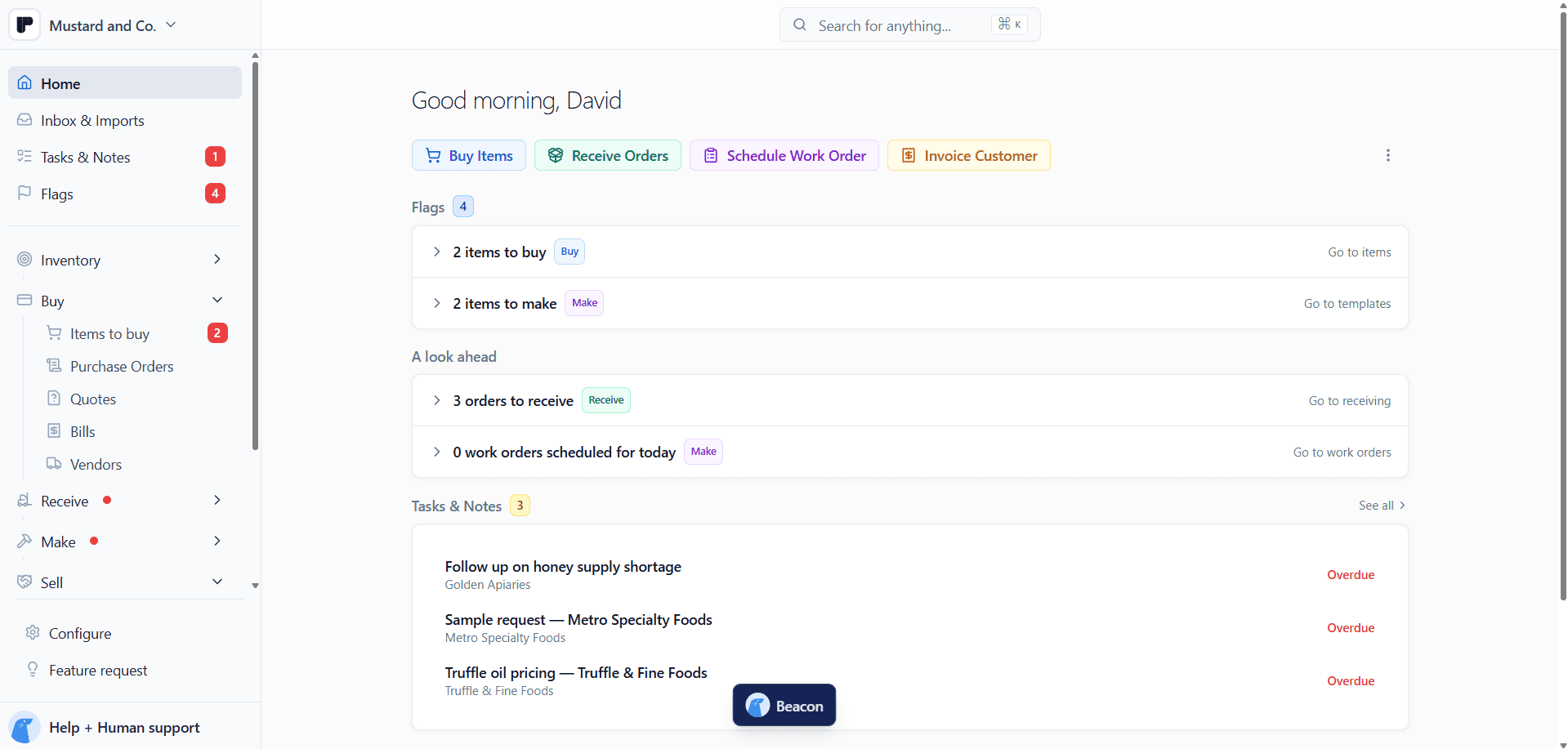
The co-packer is a vendor and a location. Add them under Vendors and, if you want to see what's at their site, as a location. Ship materials there on a transfer, and your inventory shows what they're holding.
Tolling runs at their location. Create the Work Order there. At Mark as Done, enter how much of each ingredient they used, and it comes out of their stock. The Output Location sends finished goods to your warehouse.
Turnkey runs start as a PO. On the Template, turn on Made by a co-manufacturer? and enter their fee per unit or per batch in Co-Manufacturer Cost Basis. Send the PO, and Peasy creates the linked work order.
Receiving records the real count and the lots. Enter the delivered quantity and the finished-goods Lot ID, then Receive & mark done. Pick the ingredient lots used and confirm Qty Accepted.
Freight stays with the batch. Add separately billed freight as an Additional Batch Cost before you complete the work order. It rolls into that run's cost per unit.
One limit: transfers aren't tied to a lot, so record supplier lot numbers when materials come in, before they ship to the co-packer.
Peasy is free inventory ops for CPG brands. No subscription, and no caps on items, users, or orders. The co-packer page shows how it works, and the help guide has the steps for both kinds of deal.
Costs and regulations checked October 2026.
Article written by
Peasy